Do AI pet portraits actually look like your pet?
Usually yes for the build, the coat colour and the general shape of the face, and that is enough for most people. The failures are specific rather than general: markings that are not symmetrical, one differently coloured eye, unusual ears, and faces so flat that small errors are obvious. What decides it more than anything else is the photographs you send.
In short
- Owners judge likeness by markings, not by anatomy, and they do it in about a second. That is the bar, and it is a specific one.
- The photographs you send matter more than the style you pick. Several angles in good light are the whole of the input problem.
- Four cases are genuinely harder: asymmetric markings, odd-coloured eyes, unusual ears, and very flat faces.
- Painted styles are judged more generously than photographic ones, which is part of why they are what people frame.
- Check on your own animal for nothing before paying, and let somebody else in the house be the judge.
What owners actually mean by likeness
Ask someone whether a picture looks like their dog and they do not check the anatomy. They check one or two specific things, almost instantly, and those things are nearly always markings: the white flash on the chest, the one dark ear, the smudge on the muzzle that is off-centre. Get those right and the picture is theirs. Get them wrong and no amount of correct breed shape rescues it.
This is why a generic portrait of the right breed is worth nothing to the person who owns a specific animal. A golden retriever that is merely a golden retriever is a stock photograph with extra steps. The whole difficulty of the problem, and the whole of what is worth paying for, sits in the gap between the breed and the individual.
It is also why likeness is easier to judge than it sounds. You do not need to study a portrait to know whether it worked. The recognition happens or it does not, in about a second, and it happens for the people who know the animal rather than for you alone.
What the photographs you send decide
The single largest variable is not the style you choose or the pack you buy. It is what went in. Photographs that show the markings clearly, in decent light, from more than one angle, produce portraits that look like the animal; ten near-identical frames of a dark shape in a dim room do not, and nothing downstream can invent the information that was never in them.
The specific failures are predictable. If every picture is taken from above, the face gets the foreshortened proportions of every picture. If every picture is from one side, the markings on the other side are guesswork. If the coat is never properly lit, its colour is being inferred from a bad sample rather than observed.
That is a solvable problem and it costs one afternoon. What makes a good photo to upload is the checklist version, and if your animal is dark-coated then photographing a black dog is the specific case that most often produces disappointing results for reasons that were fixable at the start.
- Several angles beat several copies of one angle.
- Daylight beats a bright room, and both beat a flash.
- The markings have to be visible in at least a few of the pictures, or they are being guessed at.
- Recent pictures, if the animal has changed — coats grey, faces whiten, puppies stop being puppies.
Where it goes wrong, honestly
Four cases account for most disappointment, and they are worth knowing before rather than after. Asymmetric markings are the first: a face where one side is dark and the other is white is a pattern that has to be reproduced exactly, and a near miss reads as the wrong animal rather than as a small error.
The second is odd eyes — one blue and one brown, which some huskies and merles have — because it is a small detail carrying a large amount of identity. The third is ears that are not the standard shape for the breed, whether that is a natural variation or an old injury. The fourth is very flat-faced breeds, where the whole face occupies a small area and there is nowhere for an error to hide.
None of these are hopeless, and all of them improve sharply with better input: more angles, better light, and pictures that show the unusual thing clearly rather than incidentally. But they are the cases where checking first is worth more than usual.
| The feature | Why it is hard | What helps most |
|---|---|---|
| Markings that are not symmetrical | A near miss reads as a different animal, not as a small mistake | Pictures of both sides of the face and body, evenly lit |
| One differently coloured eye | A very small detail carrying a lot of the animal's identity | At least one sharp, front-on frame where both eyes are clearly visible |
| Ears with an unusual shape or a past injury | It reads as an error rather than as the animal's own feature | Frames from the front and from both sides, with the ears up |
| Very flat faces | Everything is packed into a small area with nowhere to hide a slip | Closer, sharper pictures taken at the animal's own eye level |
Painted styles are a different question
A painting is judged differently from a photograph, and more generously. Nobody expects an oil portrait to be accurate in the way a photograph is accurate, and a painterly interpretation of a coat can carry a likeness that would look like an error in a photographic style. This is the same latitude a human portrait painter has always had.
That cuts both ways. If what you want is a faithful record of exactly how this animal looks right now, a photographic style is the honest choice and a painted one will always be interpreting. If what you want is something to hang on a wall, the painted styles are usually the ones people frame.
The full comparison against paying somebody to paint one is on the commissioned painting page, including the part where a commission takes weeks and a portrait does not.
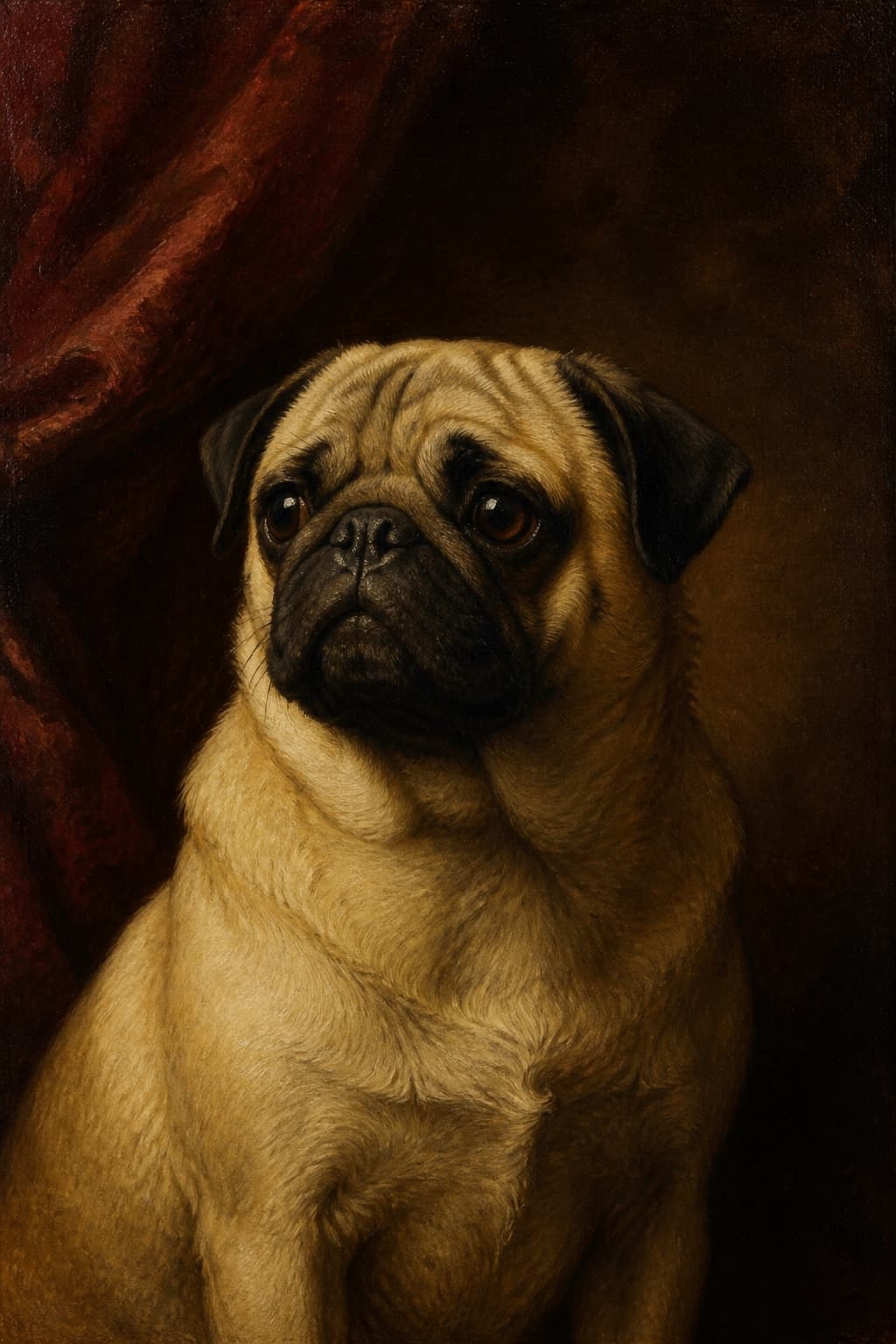
A painted style is judged on whether it feels like the animal rather than on whether it matches them pixel for pixel, which is a materially easier test to pass.
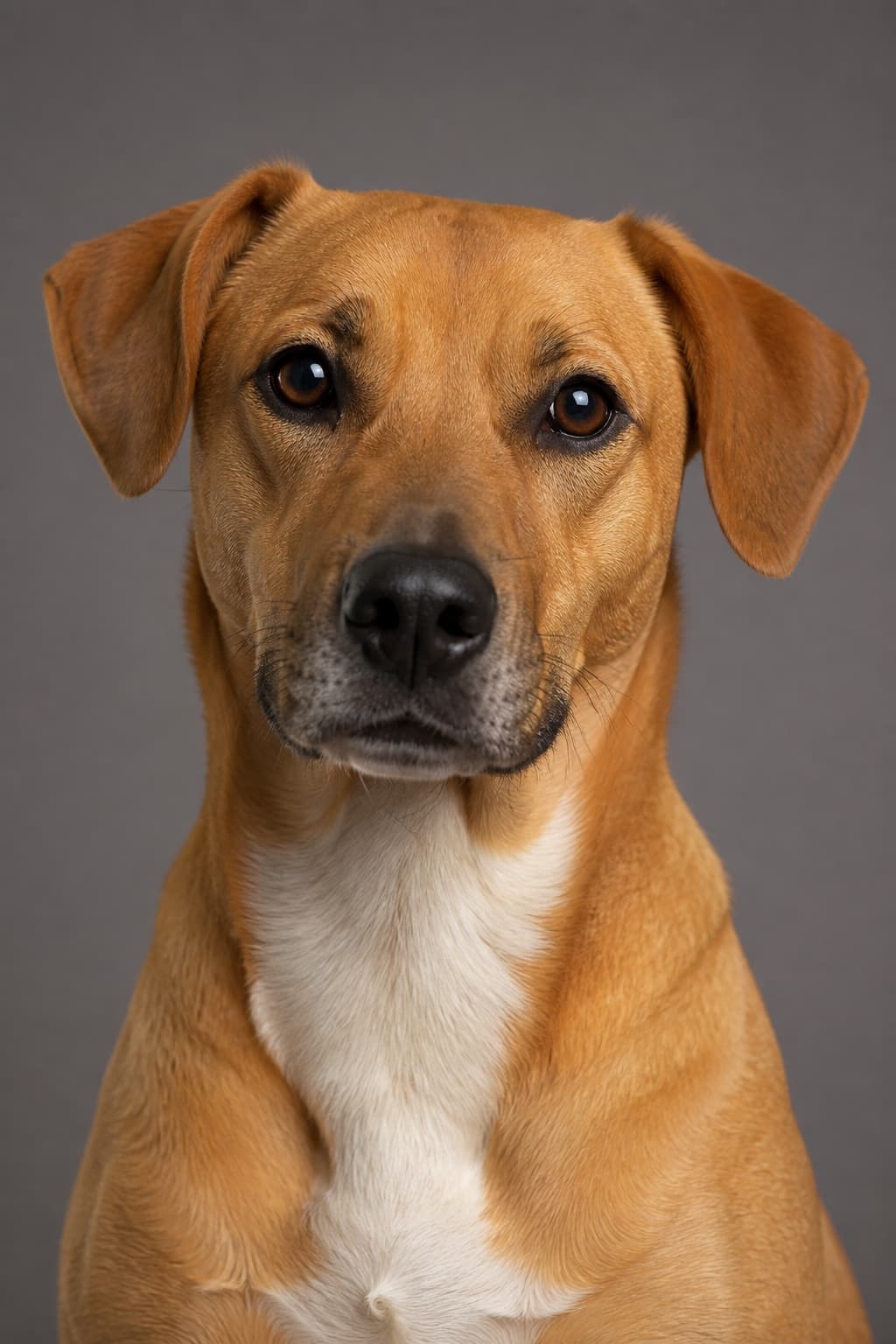
The strictest test in the catalogue: a plain background and even light leave nothing to distract from the markings, so any error in them is the first thing seen.
Created with PetPhotos from a described animal, not a customer's photos. Not stock photography.
How to find out before you pay
The reason this question is answerable rather than theoretical is that you can check it on your own animal for nothing. A free preview takes one set of photographs and produces one portrait, which is enough to tell you whether the likeness holds for your specific pet rather than for a well-behaved example on a marketing page.
Look at it the way the people who know the animal will. Show it to somebody in the house without saying what it is and see whether they name the pet. That is a better test than studying it yourself, because you already know what it is supposed to be and they do not.
If it works, it works, and our own examples show what the styles look like on animals that are not yours. If it does not, you have lost an afternoon of photograph-taking and no money. That is the whole argument for trying it first rather than reading more pages like this one.